
Why is 2D Technical Drawing Still Important?
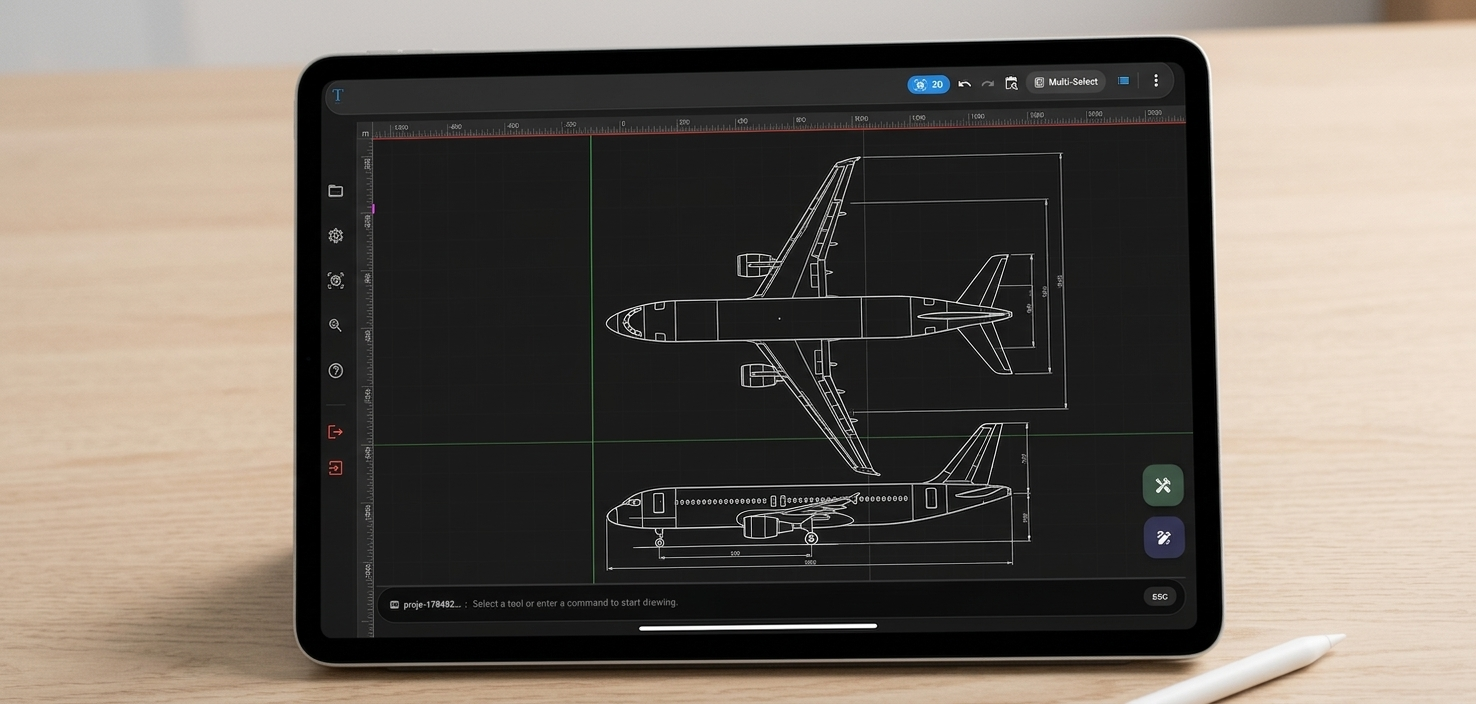
3D modeling and visualization technologies are developing every day. In architecture, engineering, and manufacturing, three-dimensional models have become an important part of the design process. However, even as 3D technologies become increasingly widespread, an important question remains: Why is 2D technical drawing still being used?
The main reason is that 2D drawing is not simply a design method. Technical drawings are an important communication tool for clearly and accurately transferring dimensions, geometry, details, sections, and other information required for production.
For this reason, 2D CAD continues to be used in architecture, engineering, manufacturing, CNC, furniture, interior design, technical education, and many other fields, despite the development of 3D design technologies.
What Is 2D Technical Drawing?
2D technical drawing is the representation of an object, structure, or component on a two-dimensional plane using specific dimensions and geometric information.
Basic geometric information such as length and width is used in these drawings. When necessary, dimensions, layers, line types, sections, symbols, and annotations can be added to make the technical information easier to understand.
In computer-aided design systems, these processes can be carried out using 2D CAD tools. Users can create and edit technical drawings using lines, arcs, circles, polylines, and other geometric elements.
Why Do We Still Need 2D Drawing When 3D Design Exists?
3D modeling makes it easier to understand a design in three dimensions and examine it from different angles. However, accessing every piece of technical information through a three-dimensional model is not always the most practical approach.
For example, when manufacturing dimensions, hole diameters, center distances, or specific section information need to be clearly communicated, a standardized 2D technical drawing can provide a much more direct way of presenting the information.
Therefore, 2D and 3D do not have to be competitors. Instead, they can be used together as two different working approaches that address different needs within the design process.
The Importance of 2D Technical Drawing in Architecture
Although 3D modeling and visualization are important in architectural projects, two-dimensional drawings such as plans, sections, and elevations continue to be fundamental tools for project communication.
On an architectural plan, walls, doors, windows, dimensions, and various project details can be represented in a structured way. These drawings help communicate design and technical information at different stages of a project.
Clear dimensions and accurate geometry are particularly important during application and detail drawing stages.
2D CAD in Engineering
In engineering, technical drawings can be used to communicate specific characteristics of designed components or systems.
In machine components, mechanical systems, electrical projects, and various technical applications, two-dimensional drawings can make dimensions, connection points, and geometric relationships easier to understand.
For this reason, 2D CAD software continues to play an important role in engineering, particularly in technical documentation and production-oriented drawing processes.
2D Drawing in Manufacturing and CNC Processes
Manufacturing is another important area where 2D technical drawing is used. Two-dimensional drawings can be useful in processes where specific geometries need to be cut, machined, or transferred to production.
In CNC applications, DXF file formats also play an important role when preparing, checking, and transferring geometries between different systems.
Therefore, 2D CAD is not simply about drawing on a screen. Turning the prepared geometry into technical data that can be used in a manufacturing process is also an important application of 2D drawing.
One of the Biggest Advantages of 2D Technical Drawing: Clarity
One of the main purposes of a technical drawing is to communicate information about a designed object or structure as clearly as possible.
In 2D drawings, views, dimensions, and geometric relationships can be displayed directly on a defined plane. This can help the person reviewing the drawing evaluate the required technical information more quickly.
Especially during manufacturing or application stages, the readability of a drawing is important for ensuring that the design is interpreted correctly.
What Advantages Does Working with 2D CAD Provide?
Modern 2D CAD software can make technical drawing more controlled and organized compared with traditional drawing methods.
- Precise drawing: Geometries can be created using specific coordinates and dimensions.
- Easy editing: Drawing elements can be modified, moved, or reorganized when necessary.
- Layer management: Different drawing elements can be organized into separate layers, making project management easier.
- File sharing: Technical drawings can be transferred to other working environments using different file formats.
- Reusability: Existing drawings can be modified and reused to create new projects.
- More organized workflow: Snap, grid, dimensioning, and editing tools can make technical drawing easier to control.
2D Technical Drawing Is Not Only for Professionals
When we talk about technical drawing, we should not think only of large engineering offices or professional CAD operators.
Architecture and engineering students, technical education students, designers, technicians, CNC professionals, and users working in various manufacturing fields can also benefit from 2D CAD tools.
Especially during education, 2D drawing can provide an important foundation for learning geometric thinking, dimensioning, and the principles of technical drawing.
The Connection Between 2D CAD and Mobile CAD
When CAD work is limited to desktop computers, the working environment of users who need to create technical drawings can also be restricted. However, as mobile devices continue to improve, technical drawing workflows can become more portable.
The mobile CAD approach brings the basic 2D CAD workflow to portable devices such as smartphones and tablets, allowing users to access their technical drawings in different environments when needed.
Tablets in particular can provide a larger screen area, while touchscreen interaction and the option to connect a physical keyboard can make mobile CAD suitable for different working scenarios.
To learn more about mobile CAD, you can also read our article: What Is Mobile CAD? Bringing Technical Drawing from Computer to Tablet .
From 2D Drawing to 3D Visualization
The fact that 2D drawing is still important today does not mean that three-dimensional technologies are unnecessary. On the contrary, using both approaches together can make it possible to understand a design from both technical and visual perspectives.
Examining a technical drawing through a three-dimensional view can help users evaluate the geometry from another perspective.
TamgamCAD's 2D → 3D visualization feature is also built around this approach. Prepared 2D geometries can be visualized in three dimensions to help users examine the design from another perspective.
To see how this feature works in more detail, take a look at our article: Visualizing 2D Technical Drawings in 3D .
The Future of 2D Technical Drawing
Design technologies continue to evolve. 3D modeling, parametric design, visualization, and various digital manufacturing technologies are transforming the CAD world.
However, the emergence of new technologies does not necessarily mean that previously established methods will disappear completely. Because of its clear, measurable, and technical information-oriented structure, 2D technical drawing can continue to be used in many fields.
In the future, the more important approach may be to choose the right method according to the needs of a project rather than choosing only between 2D and 3D tools.
Conclusion: 2D and 3D Are Not Competitors
Why is 2D technical drawing still important? Because technical information does not always have to be communicated through a three-dimensional model.
From architectural plans and sections to engineering drawings, manufacturing geometries, and CNC processes, 2D CAD continues to be an important tool for communicating technical information clearly and in a controlled way.
3D modeling, meanwhile, can help users understand these drawings and designs from a different perspective. For this reason, using 2D and 3D together is likely to remain a natural approach in the future of CAD workflows.
TamgamCAD brings together 2D technical drawing tools, a mobile working experience, and 2D → 3D visualization features based on this approach.
Bring Your 2D Technical Drawing Work to Mobile
Create and edit technical drawings, work with DXF files, and explore your prepared 2D geometries from a different perspective with TamgamCAD.
Explore TamgamCAD